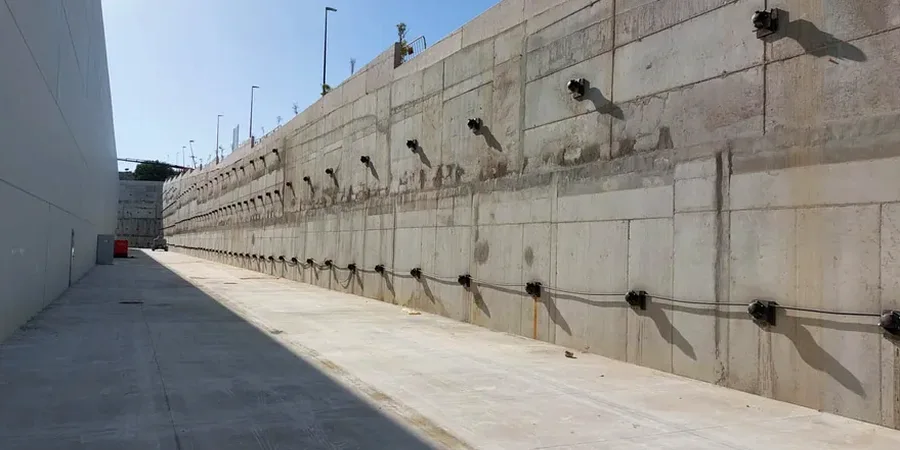
Fort Worth sits on the Woodbine Formation: a Cretaceous-age sequence of claystone, shale, and interbedded sandstone that weathers into a stiff, fissured profile. When the Eagle Ford Group outcrops east of the Trinity River, sulfate-rich groundwater accelerates steel corrosion in conventional tiebacks. The anchor design has to account for 35 to 70 feet of weathered shale before reaching competent rock, and the active clay fraction means creep must be controlled through proper unbonded length and lock-off load. For deep excavations along the Clear Fork or the Cultural District’s parking garages, a retaining wall often relies on multi-level strand anchors proof-tested to 133 percent of design load, while passive bar anchors serve restrained basement slabs where space is tight.
In Fort Worth's Eagle Ford shale, a properly designed double-corrosion-protected anchor can retain a 40-foot cut for 75 years with less than 2 percent load loss.
Technical details of the service in Fort Worth
Procedure video
Risks and considerations in Fort Worth
Summers in North Texas deliver 34 inches of rain in cloudbursts, and the claystone swells enough to add unexpected compression load behind anchor walls. A passive anchor embedded in active-zone clay can see bending strains exceed yield if the bond breaker isn't extended through the full expansive depth — roughly 12 feet in Fort Worth subdivisions with mature oak trees. The real threat is hydrogen embrittlement from cathodic interference: old streetcar lines and stray currents from the downtown transformer vaults have caused brittle failure in unprotected high-strength bars. The anchor design specification now mandates electrical isolation at the bearing plate and a minimum 1.5-inch grout cover over any steel. For projects near the Trinity River levees, liquefaction analysis during the 2,475-year flood event determines whether the anchor bond zone must be extended below the potentially liquefiable sand lenses that appear at 25 to 40 feet.
Our services
Anchor design in Fort Worth spans two distinct demand profiles: high-capacity active tiebacks for shoring and restrained passive anchors for buoyancy control. Each project includes load test documentation and corrosion audit.
Active Strand Anchor Design
Prestressed multi-strand anchors for soldier pile and secant walls, with bonded zones in Woodbine shale or limestone. Includes load-elongation modeling, lock-off sequence, and lift-off acceptance criteria per PTI DC35.1.
Passive Bar Anchor and Deadman Systems
Grade 80 threaded bar anchors for mat foundation uplift restraint and restrained basement slabs. Bond breaker detailing through expansive clay zones, plus double-nut head assemblies with load-indicating washers for long-term monitoring.
Quick answers
What is the typical cost range for anchor design and testing in Fort Worth?
How does Fort Worth’s expansive clay affect the unbonded length?
The active zone of seasonal moisture change extends about 12 feet deep in Fort Worth. The unbonded length must pass entirely through this zone, and a bond breaker — usually a smooth PVC sleeve filled with wax — prevents the swelling clay from transferring compression load to the tendon. The minimum unbonded length is 15 feet or one-tenth of the excavation height, whichever is greater.
Why is corrosion protection Class II required for permanent anchors here?
Sulfate concentrations in the Eagle Ford groundwater, combined with the high electrical resistivity of dry Woodbine shale, create a macrocell corrosion risk. PTI Class II double protection — factory-greased strand inside corrugated HDPE sheathing, plus a trumpet at the anchor head — has been the Fort Worth standard since 2010, especially for anchors that serve parking structures with deicing salt exposure.
What proof test procedure do you follow for active tiebacks?
We follow PTI DC35.1: the anchor is loaded in increments to 133 percent of design load, held for 10 minutes, and creep is measured with a dial gauge at the stressing jack. Total movement during the hold must not exceed 0.04 inches; if it does, the anchor is restressed and retested after grout reaches full strength.
Can passive anchors replace active tiebacks in a deep Fort Worth excavation?
Generally no. Passive anchors develop load only after the wall deflects, which can exceed allowable movement in the stiff clay of downtown Fort Worth. Active tiebacks are preloaded to 110 percent of design load, locking in the load before excavation proceeds, and they keep lateral deflection under 1 inch for a 30-foot cut adjacent to existing buildings.