Fort Worth started as an army outpost in 1849, but its real growth exploded with the railroad and later the oil boom. That rapid expansion pushed development onto the Eagle Ford Shale and Woodbine formations that wrap around the Trinity River. In our experience, the biggest variable here isn't the structural load; it's the clay's affinity for water. Before a single footing is poured, we run Atterberg limits to classify the fine-grained fraction. This isn't about checking a box. It's about predicting how the soil will behave through North Texas droughts and the spring rainy season. When the plasticity index climbs above 25, standard prescriptive foundation widths become a gamble. We pair these results with grain size analysis to separate the silt from the true clay fraction, which directly controls the shrink-swell potential under the slab.
The plasticity index from an Atterberg test tells us more about a foundation's long-term performance than a dozen consolidation curves.
Technical details of the service in Fort Worth
Risks and considerations in Fort Worth
The IBC references ASTM D4318 indirectly through the soil classification requirements of Chapter 18. In Fort Worth, where the summer heat bakes the ground into deep desiccation cracks, the risk isn't just cracking drywall. It's differential heave that can lift a corner of the slab by two inches in a single wet season. We've pulled cores from distressed slabs in the Monticello neighborhood where the underlying clay had a PI of 45, but the original geotech report only listed a visual classification. That's a lawsuit waiting to happen. When you skip the Atterberg test, you're designing blind. The plasticity index directly feeds into the BRAB method for slab-on-grade design and into the TxDOT soil support values for pavement sections. For sites near the river, the clay layers are often interbedded with silt lenses, which is why we recommend running in-situ permeability tests alongside the Atterberg work to understand how water moves through the profile.
Our services
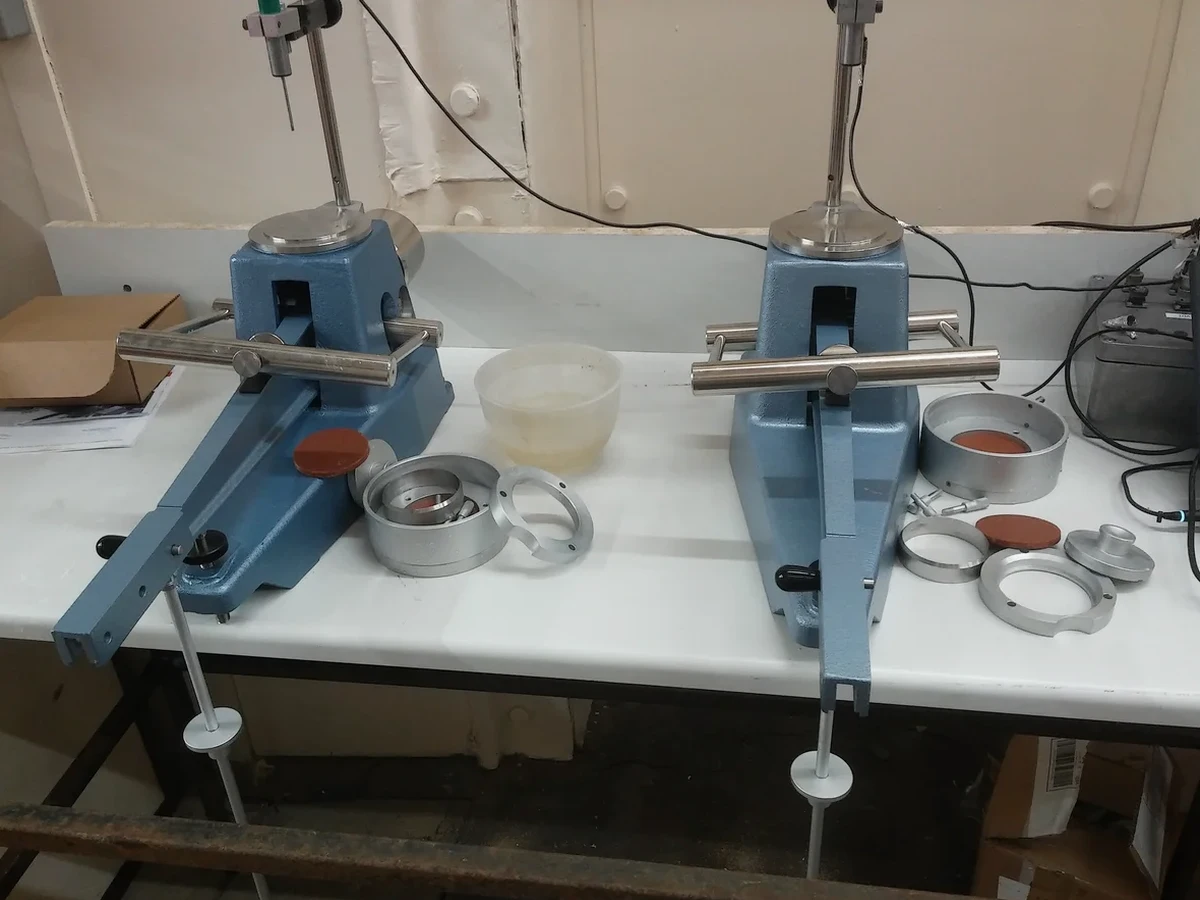
Our Fort Worth lab runs these tests daily, not once a month. That frequency matters because the Casagrande cup cam needs constant calibration, and the water content oven needs to be dead-on at 110°C. We offer two service paths depending on your project stage.
Preliminary Site Screening
For undeveloped tracts in Parker County or near Eagle Mountain Lake, we run Atterberg limits on bag samples from test pits to map the shrink-swell potential across the site early in the design phase.
Forensic and Remedial Testing
When a slab is already moving, we extract thin-wall tube samples from beneath the foundation and run both Atterberg limits and suction tests to quantify the active zone moisture profile.
Quick answers
How much does Atterberg limits testing cost in Fort Worth?
Why is the plasticity index so critical for foundations in Fort Worth?
The plasticity index (PI) directly correlates to the soil's ability to absorb water and swell. The expansive clays in the Eagle Ford formation commonly have PIs between 30 and 50. A PI above 25 indicates high expansion potential, which requires a suspended slab or a deepened perimeter beam. Without the PI number, you can't reliably apply the Post-Tensioning Institute's design method for stiffened slabs.
Can you run Atterberg limits on a sample you didn't collect?
Yes, we can test bag samples or tube samples provided by your drilling crew, as long as the material is properly sealed and has not dried out. However, for critical projects, we prefer to handle the sampling ourselves through our SPT drilling division because the water content at the time of sampling affects the liquid limit result.