A foundation that works perfectly in the limestone-ledged terrain of western Fort Worth can fail completely three miles east in the Eagle Ford clay formations near the Trinity River. The soil variability across Tarrant County creates a real challenge for structural engineers and contractors: one site might have 20 feet of stiff clay with moderate swell potential, while another sits on shallow bedrock with completely different load-transfer behavior. Raft or mat foundation design becomes the logical solution when conventional spread footings would require excessive depth or when differential settlement threatens the structure’s performance. We approach each Fort Worth project by first characterizing the subsurface through site-specific borings and laboratory testing, then modeling how the entire mat will interact with the underlying strata under both static and seismic load combinations. The result is a foundation system that distributes building loads over a large enough area to keep bearing pressures well within the allowable limits for the native soil, even when moisture-driven volume changes occur seasonally. This type of analysis frequently requires integrating data from in-situ permeability testing to predict how water migration through the profile will affect long-term clay behavior beneath the slab.
In Fort Worth's Eagle Ford shale, a well-designed mat foundation reduces differential settlement to under 0.5 inches across 100 feet of slab—something isolated footings simply cannot achieve on these expansive clays.
Technical details of the service in Fort Worth
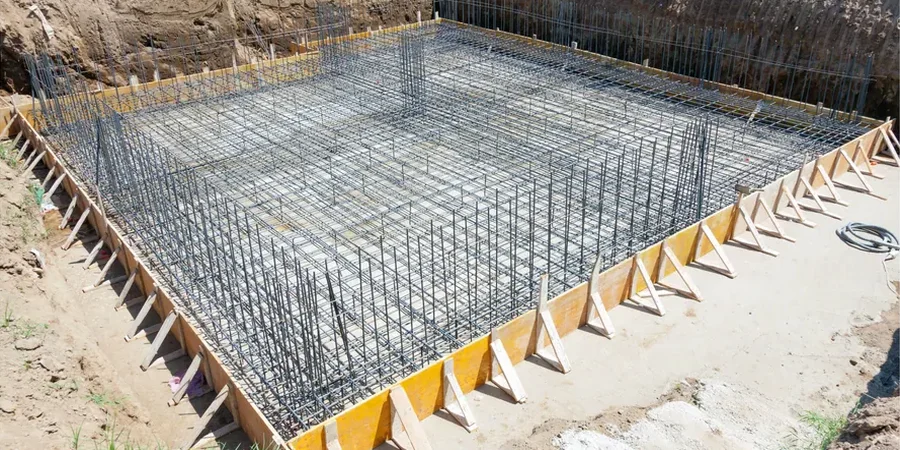
Risks and considerations in Fort Worth
The semi-arid climate of North Texas, with annual rainfall averaging 36 inches but concentrated in spring and fall storm events, creates a wet-dry cycling pattern that is particularly aggressive on expansive foundation soils. Fort Worth’s summers bring prolonged 100-degree-plus days that desiccate the upper 8 to 15 feet of clay, opening shrinkage cracks that later become conduits for rapid water infiltration during the next heavy rain. A raft/mat foundation must be designed with this moisture-swing reality in mind: the perimeter beam should extend below the active zone of seasonal moisture fluctuation, typically 9 to 12 feet in Tarrant County, and the underslab vapor barrier must resist punctures during placement while maintaining a perm rating below 0.1 perms. Sulfate attack is another concern in the Eagle Ford formation, where soil sulfate concentrations frequently exceed 0.3 percent by weight, triggering the requirement for Type V cement or equivalent sulfate-resistant mix designs per ACI 318.19 Chapter 19. Ignoring these local geochemical and climatic factors leads to foundation distress within the first five years, often manifesting as edge lift or center heave that costs more to remediate than the original mat construction.
Our services
Our Fort Worth raft/mat foundation design package delivers a complete subgrade-to-slab solution. Each project includes site investigation coordination, laboratory testing direction, geotechnical parameter derivation, and structural design of the mat element itself, all calibrated to Tarrant County subsurface conditions.
Geotechnical Site Characterization for Mat Design
We specify boring locations, depths, and sampling intervals tailored to the planned mat footprint. Laboratory testing includes Atterberg limits, swell-consolidation (ASTM D4546), unconfined compression, and sulfate content to build a defensible design profile for the mat foundation subgrade.
Settlement and Bearing Capacity Analysis
Using finite element or layered-elastic models, we calculate immediate and consolidation settlement under the full mat geometry, checking both center and edge points. Bearing capacity is verified for the controlling load combination using Vesic or extended Meyerhof methods on the equivalent mat bearing area.
Structural Mat Design and Reinforcement Detailing
The concrete mat is designed for flexure, one-way and two-way shear per ACI 318, with reinforcement layouts optimized for the column grid and any point loads from equipment or shear walls. We provide full CAD-ready plans with bar schedules, lap splice locations, and construction joint details.
Quick answers
At what depth should the perimeter beam of a raft/mat foundation be placed in Fort Worth's expansive soils?
The perimeter beam should extend at least 9 to 12 feet below finished grade to reach below the active zone of seasonal moisture fluctuation. In the Eagle Ford formation, we recommend a minimum 12-foot embedment where plasticity indices exceed 25, verified by a geotechnical boring at each corner of the proposed mat.
Is a raft/mat foundation always necessary on Fort Worth clay, or can I use a conventional slab-on-grade?
A conventional slab-on-grade with stiffening beams can work for lightly loaded one- and two-story residential structures on moderate PI clays, but for commercial buildings with column loads above 50 kips or where differential settlement must stay under 0.5 inches, a structurally designed mat foundation becomes the safer and more predictable option.
How do you handle sulfate attack in the concrete mix for a mat foundation in Fort Worth?
We specify sulfate-resistant cement (ASTM C150 Type II or Type V) when soil sulfate concentrations exceed 0.10 percent water-soluble by mass, which is common in the Eagle Ford shale. For severe exposure (over 0.20 percent), the water-cement ratio is limited to 0.45 maximum and the minimum concrete cover to reinforcement is increased by 0.5 inches per ACI 318.19 durability requirements.
What is the typical cost range for a raft/mat foundation design in Fort Worth?
How long does the design process take from initial site investigation to final stamped drawings?
A typical timeline runs 4 to 6 weeks: site investigation and laboratory testing take 2 to 3 weeks, geotechnical parameter derivation and settlement modeling take 1 week, and structural mat design with drafting takes an additional 1 to 2 weeks. Complex sites requiring ground improvement or deeper borings may extend the schedule by 2 weeks.