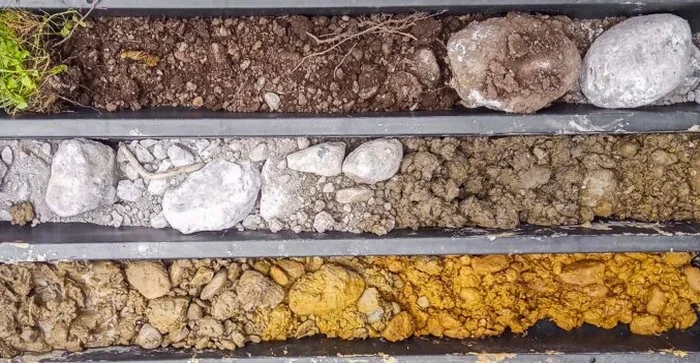
Fort Worth sits on the Eagle Ford Shale and Woodbine formations, where seasonal moisture swings create some of the most aggressive shrink-swell clays in Texas. Between the dry summers and the occasional heavy rains, the soil here moves enough to crack slabs and displace footings if you don't know exactly what you're dealing with. That's where an exploratory test pit comes in. It lets you see the stratification with your own eyes, not just through a split spoon. Our team logs the profile according to ASTM D2488 and takes bulk samples for laboratory classification. For deeper investigation below 12 feet, we often pair the test pit with spt drilling to get blow counts in the underlying shale or limestone bedrock that controls bearing capacity across Tarrant County.
Seeing the soil profile firsthand in an exploratory test pit removes the guesswork that borehole logs alone can leave behind.
Technical details of the service in Fort Worth
Risks and considerations in Fort Worth
Fort Worth grew fast after the 1990s, pushing residential subdivisions into areas that were once ranchland with undocumented fill. We've opened exploratory test pits in neighborhoods like Wedgwood or near TCU where we found old construction debris, tree stumps, and even buried concrete washouts under what looked like undisturbed grass. That kind of surprise stops a foundation crew cold. The city's geotechnical hazard is not just expansive clay; it's also the variability introduced by decades of piecemeal development. Overlooking a test pit on a commercial pad in the Cultural District, for instance, could mean missing an old creek fill that will settle differentially under a slab-on-grade. We've learned to probe every anomaly in the trench wall with a hand auger or take an extra sample for atterberg limits testing when the plasticity looks suspiciously high.
Our services
We deliver exploratory test pit investigations tailored to the geology and construction rhythm of Fort Worth. Each service package includes field logging, high-resolution photos, GPS location of the pit, and a signed report from our senior technician.
Standard Exploratory Test Pit
Machine-excavated trench to 14 ft with full ASTM D2488 logging, pocket penetrometer profiling, and bulk sampling at each stratum change. Ideal for pre-foundation investigation on single-family and low-rise commercial lots.
Utility Clearance & Potholing Pit
Shallow test pit for daylighting existing utilities prior to directional drilling or foundation work. We coordinate with 811 tickets and document pipe materials, depths, and bedding conditions.
Forensic Test Pit Investigation
Targeted excavation to expose foundation distress causes, moisture intrusion paths, or fill anomalies. We log cracks, root penetration, and sub-slab moisture conditions for litigation support or repair design.
Quick answers
How deep can you excavate an exploratory test pit in Fort Worth?
We typically go to 14 feet with a standard backhoe or trackhoe. Deeper than that requires benching or shoring per OSHA Subpart P, which adds cost and time. In most Fort Worth sites, 14 feet gets you through the active clay zone and into weathered shale or limestone, which is enough for foundation design decisions.
What does an exploratory test pit cost in the Fort Worth area?
Can you use a test pit instead of a boring for my foundation permit?
Sometimes, but not always. The City of Fort Worth building department accepts test pit data for certain residential permits when the log meets ASTM D2488 and covers the depth of influence. If the site has questionable bearing or requires deeper investigation into bedrock, they may also ask for an SPT boring to confirm blow counts. We'll tell you which approach fits your permit path before we mobilize.
How do you handle backfill and site restoration after the pit is logged?
We backfill in controlled lifts with the excavated material, compacting each lift with the excavator bucket or a plate compactor where access allows. If the client needs a more permanent seal, we can use controlled low-strength material (CLSM) instead. We leave the surface graded to drain and match the surrounding grade as closely as possible.