We see it often in Fort Worth: a geotechnical report that relies solely on pocket penetrometer readings and SPT blow counts to estimate shear strength for a retaining wall or slope cut. Then the rainy season hits the Eagle Ford shale, pore pressures spike, and a perfectly good design starts to show cracks. The problem is not the soil itself—it is the assumption that index properties can substitute for direct shear measurement. A proper triaxial test eliminates that gamble. When we run a consolidated-undrained (CU) triaxial on a saturated clay sample from the Trinity River floodplain, the effective stress envelope tells the design engineer exactly what friction angle and cohesion to plug into the slope stability model. For the stiff limestone residuum on the west side of town, a drained test gives you the peak strength before strain softening kicks in. This is the kind of data that separates a project that holds up from one that requires expensive remediation.
Blow counts tell you density. Triaxial testing tells you how the soil actually fails under the confining stress your foundation will impose.
Technical details of the service in Fort Worth
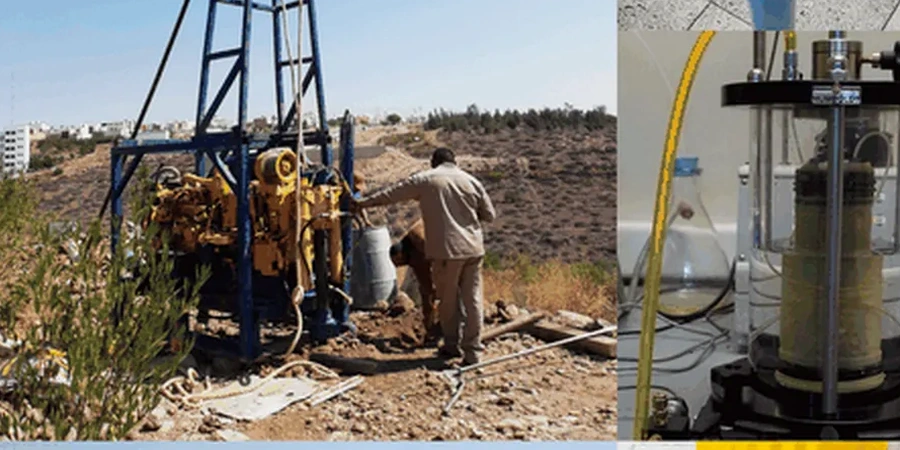
Risks and considerations in Fort Worth
One thing we have learned working the Fort Worth formation is that the weathered shale zone—that crumbly, gray-brown material just above the unweathered bedrock—does not behave the way a textbook clay does. It has fissility, it has relic bedding planes, and its undrained strength drops fast once the strain exceeds about 2 percent. If the triaxial program does not include a multi-stage CU test with pore pressure measurement, the designer ends up using a friction angle that is five or eight degrees too optimistic. We have seen slope failures along the Clear Fork of the Trinity where the post-failure investigation traced the slip surface right through that weathered transition zone. The triaxial data on the intact samples looked fine; the problem was that nobody ran a test on a specimen oriented with the bedding at 45 degrees. Now our standard protocol for shale projects in Tarrant County includes at least one oriented specimen per boring, plus a slope stability analysis that uses the residual strength envelope, not just the peak.
Our services
Our triaxial testing program in Fort Worth covers the full range of shear strength characterization that local projects demand, from routine foundation design to forensic failure investigations.
CU Triaxial with Pore Pressure Measurement
The workhorse test for Fort Worth clay and shale. Specimens are saturated under backpressure, consolidated to the estimated in-situ effective stress, then sheared undrained while we log excess pore pressure. You get the effective stress friction angle φ' and cohesion c'—the parameters that go directly into effective stress slope stability models, retaining wall design, and bearing capacity calculations where groundwater is a factor.
Multi-Stage Triaxial for Limited Samples
When the Shelby tube yields only one good specimen and the boring log shows three distinct strata, we run a multi-stage test: shear to about 3 percent axial strain, stop, increase confining pressure, re-consolidate, and shear again. This gives you a strength envelope from a single specimen. We apply this technique regularly on the thin weathered shale seams that characterize the Fort Worth Prairie, where sample recovery is always a challenge.
Quick answers
How much does a triaxial test program cost for a Fort Worth project?
A standard program with three CU triaxial tests on 2.8-Multi-stage tests or CD triaxial tests on stiffer materials fall at the upper end of that range.
What is the difference between UU, CU, and CD triaxial tests?
Unconsolidated-Undrained (UU) gives total stress parameters—quick, but does not account for pore pressure and is conservative only for short-term loading on saturated clays. Consolidated-Undrained (CU) with pore pressure measurement gives effective stress parameters c' and φ', usable for both short- and long-term analysis. Consolidated-Drained (CD) is the gold standard for free-draining materials like sands and for long-term stability of stiff clays; it takes longer because the strain rate must be slow enough to dissipate pore pressure during shear.
How long does triaxial testing take from sample delivery to report?
A standard CU triaxial program on three specimens usually takes seven to ten business days. The consolidation stage alone can take 24 to 48 hours per specimen for fat clays, and the shear stage at the correct strain rate adds another day. CD tests take longer—often two to three weeks—because the strain rate is an order of magnitude slower. We can expedite if the project schedule demands it, but consolidation time is controlled by soil permeability, not by lab throughput.
Do you need undisturbed samples for triaxial testing, or can you test recompacted fill?
Both, and the purpose differs. Undisturbed Shelby tube samples give you the in-situ strength of the natural deposit—critical for slope stability and foundation design on native clay and shale. Recompacted specimens, prepared to a target density and moisture content from a Proctor curve, tell you the strength of the engineered fill after placement. For Fort Worth commercial pad sites where the fill is 8 to 12 feet thick, we recommend testing recompacted specimens at multiple moisture contents to bracket the as-built strength envelope.