A recent warehouse project off I-35W hit an unexpected layer of fat clay just three feet below the planned footing elevation. The initial visual classification missed the high silt content, and the contractor was about to pour a slab-on-grade that would have heaved within two seasons. That is where a complete grain size analysis changes the outcome. Running both sieve and hydrometer testing on a single sample separates the sand fraction from the silt and clay, giving you the full particle-size distribution curve. For Fort Worth sites sitting on the weathered Eagle Ford Group, knowing the exact percentages means the difference between a standard foundation and one that needs moisture-conditioned select fill. We run the full ASTM D422 and D6913 suite and deliver results within 48 hours so your earthwork schedule does not stall.
A soil classified by feel can be off by two USCS groups. A grain size curve measured to ASTM precision removes that guesswork and pays for itself in foundation reliability.
Technical details of the service in Fort Worth
Risks and considerations in Fort Worth
A common mistake in the Fort Worth area is relying on a simple wash-sieve without the hydrometer step, assuming the minus-200 fraction is all clay. We have seen this shortcut lead to retaining wall backfill that traps water because the supposed clay was actually rock flour behaving like a silt, non-plastic and highly erodible. A full grain size analysis catches this immediately. Without it, you risk designing drainage layers that clog, selecting filter fabrics with the wrong apparent opening size, or misclassifying a frost-susceptible silt as a clean sand. In the Eagle Ford terrain, where weathered shales produce borderline materials, missing the hydrometer is like reading only half the report. The IBC and ASCE 7 reference soil classification directly for seismic site class determination; a wrong classification can shift your site from Class C to Class D and change your design spectral accelerations.
Our services
Our grain size analysis package covers the full spectrum from coarse gravel down to colloidal clay. Every test is run in our Dallas-Fort Worth accredited lab, and we handle sampling logistics across Tarrant County.
Sieve Analysis (Coarse + Fine)
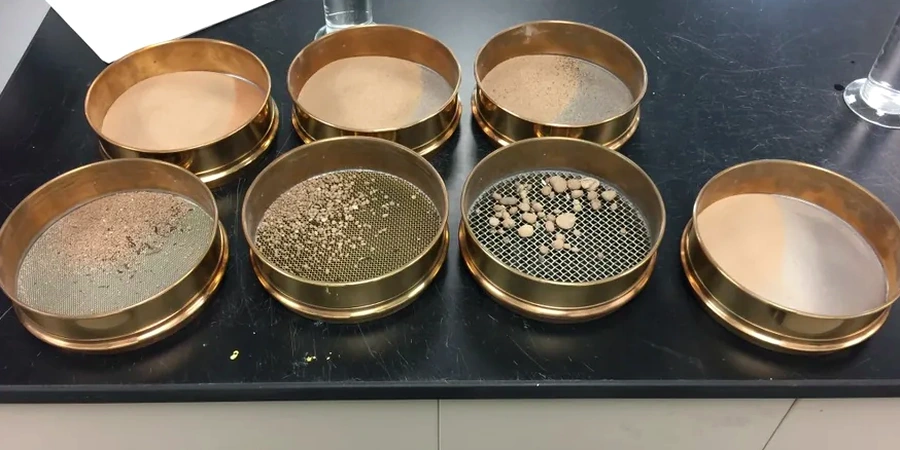
Mechanical shaking through a full nest of ASTM E11 sieves, with wash-sieve on the No. 200. We report percent retained on each sieve, cumulative passing curve, and gravel-sand-fines split for USCS classification.
Hydrometer Sedimentation Test
Type 152H hydrometer readings at 0.5, 1, 2, 4, 8, 15, 30, 60, 120, 240, and 1440 minutes. We apply temperature and meniscus corrections, compute particle diameters via Stokes' Law, and merge the curve with the sieve data for a continuous gradation from 75 mm down to 0.001 mm.
Quick answers
How much does a grain size analysis with sieve and hydrometer cost in Fort Worth?
When is a hydrometer test required instead of just a sieve analysis?
Any time more than 12 percent of your sample passes the No. 200 sieve, ASTM D2487 requires the hydrometer to define the silt-versus-clay boundary. In Fort Worth, where weathered Eagle Ford shale produces high fines content, the hydrometer is needed on roughly 70 percent of the samples we process.
How long does the complete grain size analysis take?
The sieve portion can be completed in one working day. The hydrometer sedimentation test requires a minimum 24-hour reading series. Standard turnaround is 48 hours from sample receipt; same-day sieve-only reports are available for time-sensitive earthwork decisions.
What sample size do you need for a reliable grain size analysis?
For predominantly granular soils, we require at least 5 kg of material. For fine-grained soils, 500 grams of the minus-No. 4 fraction is sufficient for both sieve and hydrometer. Samples should be sealed in plastic bags immediately after extraction to preserve natural moisture content if Atterberg limits will also be run. More info.