The 2024 edition of the International Building Code (IBC), adopted with local amendments across Tarrant County, requires a site-specific soil mechanics study for any permanent structure exceeding 400 square feet. In Fort Worth, that requirement hits differently because the subsurface rarely behaves the way a textbook predicts. We have seen Eagle Ford Group shales swell 12% in volume within 72 hours of a rainstorm in the West 7th corridor, and we have logged clean gravels at 6 feet in the Trinity River alluvium near University Drive that made a developer reconsider a mat foundation in favor of driven piles. A soil mechanics study here is not a bureaucratic step—it is the difference between a slab that stays flat for 20 years and one that cracks before the drywall goes up. The interplay between shallow limestone, desiccated clay crusts, and seasonal moisture fluctuations means we run Atterberg limits and consolidation tests on every sample, not just the ones that look suspicious. For deeper stratigraphy where SPT refusal happens above 15 feet, we often pair the lab program with a CPT test to capture continuous tip resistance and sleeve friction without losing the soft seams that split-spoon sampling misses.
In Fort Worth, the shrink-swell potential is not a footnote—it defines the foundation design, and a plasticity index above 35% changes the conversation from slab-on-grade to a suspended floor.
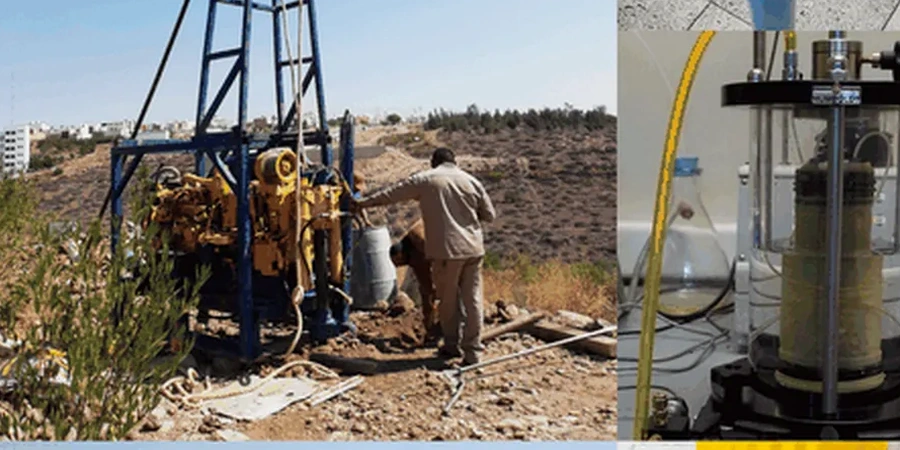
Technical details of the service in Fort Worth
Risks and considerations in Fort Worth
A 14-story mixed-use building on Lancaster Avenue taught us something we will not forget: the geotechnical report assumed a uniform clay profile, but the site straddled a buried paleochannel filled with loose silty sand. The original recommendation called for a mat foundation with an allowable bearing pressure of 150 kPa. When we ran the soil mechanics study—recovering continuous samples every 1.5 meters and running consolidation tests on the clay and drained triaxial on the sand—we found the channel material would settle 40 mm more than the adjacent clay under the same load. That differential would have sheared the plumbing risers and cracked the elevator core within two years. The fix was not cheap, but it was simple: the structural engineer switched to a deep foundation with belled piers socketed into the Goodland limestone, and the slope stability assessment for the 6-meter excavation confirmed the temporary shoring could handle the mixed-face conditions. Fort Worth does not forgive assumptions. A soil mechanics study that skips stratigraphic mapping is a liability dressed as a report.
Our services
A soil mechanics study in Fort Worth is not a single test—it is a program that combines field sampling, laboratory testing, and engineering analysis calibrated for the local geology. The following services form the backbone of most investigations we run in Tarrant County.
Foundation Design Parameter Report
We derive allowable bearing capacity, settlement estimates, and modulus of subgrade reaction from triaxial and consolidation data, formatted for structural engineers following IBC Chapter 18 load combinations.
Expansive Soil Characterization
Atterberg limits, suction testing, and volume change prediction using the TxDOT Tex-124-E method to classify swell potential and recommend moisture-conditioned fill or structural floor alternatives.
Pavement Subgrade Evaluation
California Bearing Ratio (CBR) on compacted samples, resilient modulus estimation, and lime stabilization dosage for flexible and rigid pavements in commercial parking lots and arterial roads.
Deep Foundation Soil Parameters
Undrained shear strength profiles, rock coring with RQD logging, and unit skin friction values for drilled shafts and driven piles socketed into the Goodland or Grayson formations.
Quick answers
How much does a soil mechanics study cost for a single-family home lot in Fort Worth?
For a standard residential lot under 0.5 The final number depends on access conditions, depth to limestone refusal, and whether the City of Fort Worth Development Services requires a third-party peer review for expansive soils.
What is the difference between a soil mechanics study and a standard geotechnical report?
A standard geotechnical report often focuses on field logging and index testing—borehole descriptions, SPT N-values, and basic classification. A soil mechanics study goes further: it quantifies stress-strain behavior through triaxial and consolidation testing, measures pore pressure response, and produces parameters like effective friction angle, compression index, and coefficient of consolidation. In Fort Worth, where the Eagle Ford shale can transition from stiff to soft within 2 vertical feet, those parameters are not academic—they determine whether a mat foundation works or whether you need to go deep.
Does the City of Fort Worth require a soil mechanics study for a commercial building permit?
Yes. The City of Fort Worth, through its adoption of the 2024 IBC with local amendments, mandates a site-specific geotechnical investigation—which must include a soil mechanics component—for all commercial structures. The report must be sealed by a Texas-licensed professional engineer and address expansive soil mitigation, bearing capacity, and settlement. For projects in designated flood hazard areas along the Trinity River or its tributaries, additional scour and liquefaction analysis may be required.