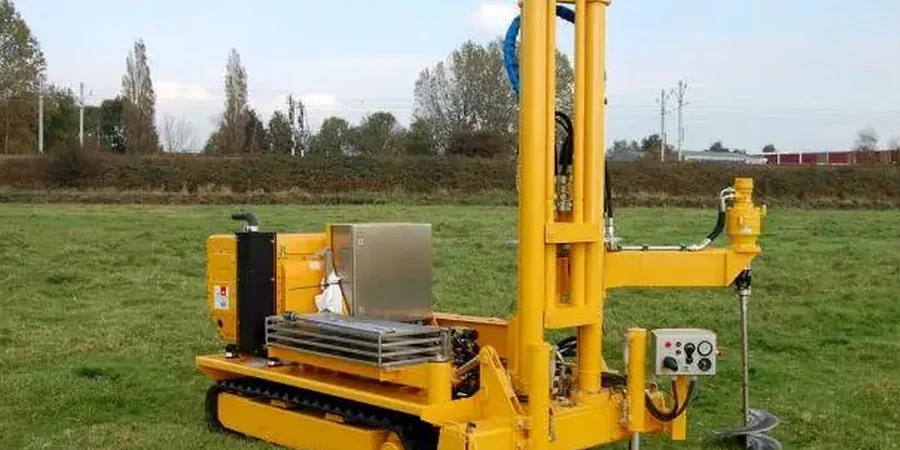
Fort Worth's growth didn't happen by accident. The city pushed west from the Trinity River floodplain into weathered shale and rolling limestone prairie, and that expansion left behind a patchwork of fill, residual clay, and competent rock that can change inside a single city block. When a standard SPT boring hits refusal at ten feet in western Tarrant County but a site three miles east shows thirty feet of stiff clay, you need continuous stratigraphy to make sense of it. That's where CPT testing earns its place. The cone penetration test gives us a nearly uninterrupted profile of tip resistance, sleeve friction, and pore pressure, and for a metro area sitting on the Barnett Shale — where depth to bedrock swings from five to forty feet depending on which creek terrace you're on — that resolution matters. We run the rig, collect the data, and our lab processes it against ASTM D5778 so your engineer can correlate directly to undrained shear strength, relative density, and soil behavior type without guessing from blow counts alone.
Continuous tip resistance and pore pressure data from a single push — when depth to shale can shift ten feet in a hundred yards, that resolution replaces assumptions with numbers.
Technical details of the service in Fort Worth
Procedure video
Risks and considerations in Fort Worth
IBC Chapter 18 and the Fort Worth building code amendments require site-specific geotechnical investigation for any structure classified in seismic design categories C or D, which covers most commercial and multifamily projects in Tarrant County. The consequence of skipping CPT or adequate subsurface exploration here isn't abstract — it's differential settlement across a mat foundation when the shale surface dips unexpectedly, or a retaining wall that fails because the design assumed drained strength in a clay that was actually generating excess pore pressure during construction. We've pulled cone logs in the TCU area where the soil behavior type flipped from silty sand to fat clay inside eighteen vertical inches, and a boring with split-spoon samples at five-foot intervals simply missed the transition. That's not a knock on SPT — it's just reality when the geology is this erratic. CPT fills the gap between widely spaced borings and gives the engineer a continuous trace of what the ground is actually doing between sample points. In liquefaction-prone alluvium near the Trinity, the cone also gives you a direct path to evaluating cyclic resistance ratio without relying on SPT-based corrections that can get noisy in silty material.
Our services
Our CPT program in Fort Worth covers the full chain from rig mobilization through data interpretation. We own the equipment, we maintain the cones, and our lab processes the raw files so your geotechnical engineer gets clean, import-ready data with soil behavior type plots already generated.
Standard CPT Sounding
Single push to 60–100 ft with 15 cm² cone per ASTM D5778. Includes tip resistance, sleeve friction, and pore pressure logs with SBT classification charts.
Seismic CPT (sCPT)
CPT with downhole shear wave velocity module for direct Vs measurement every meter. Eliminates the need for a separate MASW line — one push gives stratigraphy plus site class.
Dissipation Tests
Pore pressure dissipation monitoring at selected depths to estimate coefficient of consolidation and permeability in Fort Worth's low-permeability Eagle Ford clays.
CPT Data Processing & Reporting
Raw cone data processed through our lab QA workflow — baseline correction, zero-shift removal, normalized SBT plotting, and export in gINT or Excel format ready for your analysis.
Quick answers
How deep can a CPT rig push in Fort Worth's limestone formations?
In western Fort Worth and the Walsh Ranch corridor, our standard 20-ton rig typically reaches refusal between 20 and 50 feet when the cone encounters the weathered limestone cap above the Barnett Shale. In the alluvial soils along the Trinity River and its tributaries, 80 to 100-foot pushes are routine because the material is softer. We assess refusal criteria per ASTM D5778 — when tip resistance exceeds the cone's rated capacity or rod friction limits further advance — and can switch to a heavier rig or recommend supplemental coring if the project needs deeper rock confirmation.
What does a CPT test cost for a typical Fort Worth commercial lot?
For a standard commercial site in Tarrant County, CPT soundings typically run US$170 to US$240 per push depending on depth, location, and whether seismic CPT is included. Mobilization is quoted separately based on the number of soundings and site access conditions. We provide a lump-sum proposal after reviewing the site plan and target depths so there are no surprises.
Can CPT replace SPT borings entirely for a Fort Worth foundation design?
CPT provides continuous stratigraphy and excellent soil parameter correlation, but it doesn't retrieve physical samples. Most geotechnical engineers in the Fort Worth market use CPT to supplement a reduced number of SPT borings — the borings provide samples for lab testing and visual classification, while the CPT soundings fill in the gaps between boreholes and give high-resolution strength and consolidation data. The combination usually results in a more defensible report with fewer borings than an SPT-only program.
How long does a CPT sounding take and how soon do we get the data?
A single CPT push to 60 feet typically takes 45 to 90 minutes on site, depending on soil conditions and whether we run dissipation tests. Raw data is available the same day. Our lab processes the files within 24 to 48 hours of the field work — QA checks, baseline corrections, SBT classification, and formatted exports — so your engineer has clean data before the rig crew finishes the next site. More info.