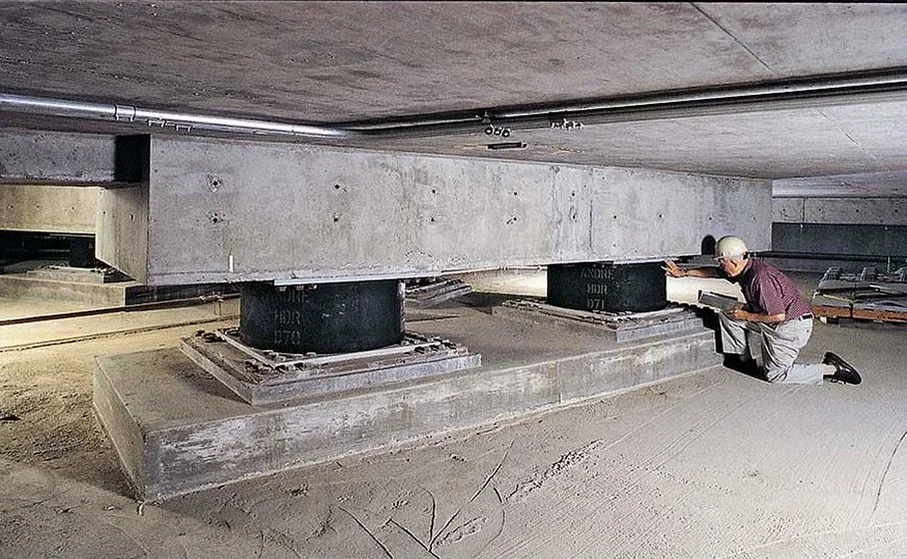
A common oversight in Fort Worth commercial construction is treating seismic isolation as an afterthought, bolted onto a structural design that was never meant to accommodate large displacement demands. The Eagle Ford Shale beneath the city triggers differential heave cycles that degrade isolation bearing performance over time, yet many project teams only address the kinematic demands without analyzing how expansive soil strains interact with the isolation plane. When the isolator pedestals tilt or bind because of subgrade movement, the entire force-reduction strategy collapses—literally and financially. We integrate geotechnical profiling with piles and footings to ensure the foundation system beneath the isolation interface remains rigid and level across decades of moisture-driven volume change.
Effective base isolation in Fort Worth depends as much on the geotechnical characterization of expansive clays as it does on the nonlinear properties of the isolation bearings themselves.
Technical details of the service in Fort Worth
Risks and considerations in Fort Worth
The Weathered Eagle Ford Shale across Tarrant County presents a shallow active zone—typically 3 to 5 meters deep—that undergoes seasonal volumetric changes exceeding 10 percent, a condition that directly compromises the rigid-foundation assumption inherent in isolation bearing specifications. If a mat foundation supporting multiple isolators experiences differential heave of just 12 millimeters, the resulting parasitic moment on lead-rubber bearings can increase the effective damping demand beyond the isolator's capacity, leading to unanticipated energy dissipation and force transfer into the superstructure. Fort Worth's proximity to the Balcones Fault Zone introduces a secondary concern: low-probability, moderate-magnitude events with source-to-site distances under 15 kilometers can produce vertical acceleration components that couple with horizontal isolation displacements, a scenario not captured by simplified response spectrum analysis alone.
Our services
Our base isolation consulting in Fort Worth bridges the gap between structural dynamics and local geotechnical behavior through a coordinated scope that begins at the subsurface and extends through nonlinear response simulation.
Site-Specific Geotechnical Characterization for Isolation Design
Deep soil borings with SPT sampling to refusal on unweathered Eagle Ford Shale, laboratory swell-consolidation testing under wetting cycles, and Vs30 profiling via MASW to establish the Site Class input for ground motion selection and scaling.
Isolation System Preliminary Sizing and Peer Review
Iterative bearing selection balancing effective period, damping ratio, and displacement capacity against Fort Worth's amplified mid-period hazard, including wind-restraint verification for the service-level condition.
Nonlinear Time-History Analysis and Performance Verification
Three-dimensional NLTHA with a suite of minimum seven spectrum-compatible ground motion pairs, incorporating soil-structure interaction springs calibrated to the site geotechnical report.
Construction-Phase Isolation Testing and Commissioning
Prototype bearing testing per AASHTO Guide Specifications, full-scale isolator shear testing at 100% MCEr displacement, and on-site installation inspection to verify pedestal level tolerance within ±3 mm across the entire isolation plane.
Quick answers
What factors most influence the cost of a base isolation seismic design project in Fort Worth?
The total design and analysis scope typically ranges from US$3,970 to US$9,210 for commercial structures in Fort Worth. The primary cost drivers are the number of ground motion pairs required for nonlinear time-history analysis—essential facilities under ASCE 7-22 Chapter 17 need a minimum of eleven pairs—and the extent of geotechnical investigation needed to characterize the expansive clay profile across the building footprint. Larger plan dimensions that require multiple borings to capture differential heave potential will increase the overall scope.
How does the Eagle Ford Shale affect long-term isolation bearing performance?
The Eagle Ford Shale weathers to a high-plasticity clay (CH) with liquid limits commonly above 60 percent. Seasonal moisture fluctuation in the upper 3 to 5 meters causes cyclic heave and shrinkage that can induce foundation tilt. For isolation bearings, this means the substructure must extend through the active zone to unweathered shale or be designed as a rigid mat with sufficient stiffness to limit differential movement to less than 3 millimeters between adjacent isolators, preserving the assumed boundary conditions in the structural model.
Is base isolation required by code for Fort Worth buildings, or is it a voluntary performance upgrade?
The IBC and ASCE 7-22 do not mandate base isolation for any seismic design category; it is a voluntary design strategy. However, for essential facilities such as hospitals, emergency operations centers, and data centers in Fort Worth, the enhanced performance objective of immediate occupancy after the MCEr event often makes isolation the most cost-effective path to meeting owner-defined resilience targets. The isolation design must still comply with all prescriptive requirements in ASCE 7-22 Chapter 17, including prototype testing and peer review.
What peer review requirements apply to base isolation designs in Texas?
ASCE 7-22 Section 17.2.4.2 mandates an independent peer review for all base-isolated structures assigned to Risk Category III or IV, and for any structure where the effective period of the isolated system exceeds 2.5 seconds. The peer review scope covers ground motion selection and scaling, isolator constitutive modeling, the nonlinear analysis methodology, and the design of all elements crossing the isolation interface, including utility connections and moat wall detailing.