Fort Worth sits on a geological boundary that makes deep excavation work particularly demanding. The Eagle Ford Group shale weathers into highly expansive clay across much of Tarrant County, while the underlying limestone can vary from competent bedrock to fractured seams within a single city block. Summer temperatures exceeding 100°F cause rapid desiccation cracking in exposed cuts, and the Trinity aquifer perched water levels fluctuate enough to catch even experienced contractors off guard. A deep excavation geotechnical analysis that ignores these local nuances simply will not hold up during construction. We combine regional drilling data with laboratory testing under ASTM D1586 and ASTM D2487 to predict how the Fort Worth strata will behave at depth, whether you are excavating near the Trinity River floodplain or up on the Western cuesta where the rock is shallower.
In Fort Worth, the weathered shale-limestone interface acts as a hidden seepage plane that transforms a routine cut into a groundwater control challenge.
Technical details of the service in Fort Worth
Procedure video
Risks and considerations in Fort Worth
The risk profile for a deep excavation shifts dramatically depending on which side of the Trinity River you are working on. East of downtown, the alluvial terrace deposits contain sand lenses and gravel stringers that can daylight into the excavation face and cause localized sloughing, especially after a heavy Texas thunderstorm. West of the river, where the rock is shallower, the hazard is different: pre-existing fractures in the Walnut Formation limestone can open up during blasting or hoe-ramming, creating unpredictable wedge failures behind the shoring. What ties both scenarios together is the speed at which conditions can change in Fort Worth. A dry cut on Monday can be pumping water by Wednesday if a summer storm recharges the perched aquifer. Our design reports include explicit trigger levels for groundwater and deformation, so the site team knows exactly when to implement contingency measures rather than making judgment calls under pressure. We also coordinate closely with the slope stability analysis group when the excavation abuts an existing embankment or roadway approach fill.
Our services
Our Fort Worth excavation design practice covers both the geotechnical and structural coordination needed to take a project from feasibility through construction support. Every deliverable is sealed by a Texas-licensed professional engineer and backed by our ISO/IEC 17025-accredited soil testing laboratory.
Excavation Support Design and Wall Selection
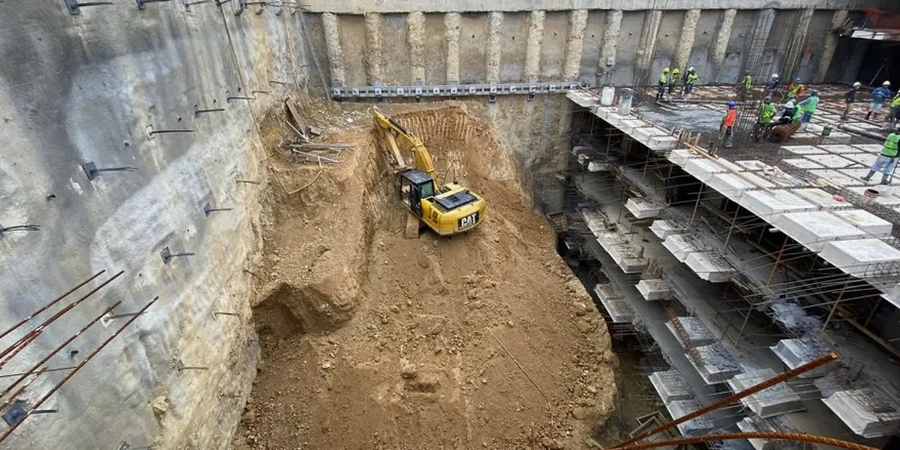
We develop shoring layouts for soldier pile, secant, diaphragm, and soil nail walls, including staged excavation sequencing, tieback or strut placement, and constructability reviews that account for Fort Worth's layered geology and right-of-way constraints.
Dewatering and Groundwater Control Design
Using site-specific permeability data and piezometric monitoring, we design dewatering systems ranging from sump pumping for shallow cuts to deep well arrays with cutoff walls for excavations extending below the Trinity aquifer potentiometric surface.
Quick answers
What is the typical cost range for a geotechnical design package for a deep excavation in Fort Worth?
For a commercial or institutional excavation in Fort Worth, the geotechnical design package typically falls between US$2,030 and US$7,590, depending on the depth of the cut, the complexity of the subsurface profile, and whether groundwater modeling and seismic earth pressure analysis are required. A straightforward soldier pile design with tiebacks on a well-characterized site will be at the lower end, while a full finite-element analysis for a 50-foot excavation adjacent to existing structures moves toward the upper range.
How does the Eagle Ford shale affect deep excavation design in Fort Worth?
The Eagle Ford Group in Fort Worth weathers to a highly plastic, expansive clay that loses significant strength when wetted. Our designs account for this by using residual shear strength parameters in the upper 15 to 25 feet and by specifying construction sequencing that limits the time the clay face is exposed before lagging or shotcrete is applied. We also require moisture-conditioned backfill in the soldier pile annulus to prevent shrinkage cracking that could compromise tieback performance.
What groundwater challenges are specific to the Fort Worth area?
The perched water within the weathered shale and limestone transition zone is the most common challenge we address. This perched system recharges rapidly after rainfall and can produce inflows of 5 to 50 gallons per minute across a typical commercial excavation face. Our designs often include a combination of horizontal drains to depressurize the transition zone and deep wells to lower the regional Trinity aquifer level when the excavation bottom approaches the potentiometric surface.
Do you provide construction-phase monitoring and observation for deep excavations?
Yes, our scope can extend through the construction phase. We specify inclinometer and piezometer locations, establish deformation trigger levels based on the adjacent structure tolerance, and provide periodic site visits to verify that the exposed stratigraphy matches the design assumptions. If conditions deviate, we issue a design memorandum with revised parameters rather than leaving the contractor to interpret the change independently.