Fort Worth sits at roughly 653 feet above sea level, straddling the Cretaceous-age Eagle Ford Shale and the younger Quaternary alluvium of the Trinity River basin. That geological contrast means one project might hit competent shale at 15 feet while another, just two miles east near the river, encounters 40 feet of soft, compressible clay before reaching anything reliable. In our experience working across Tarrant County, stone column design becomes the practical bridge between what the ground offers and what the structure demands. Rather than deep foundations that punch through the entire soft zone, a properly designed array of compacted gravel columns reinforces the native soil mass, creating a composite ground that handles bearing loads and keeps total and differential settlements within tolerable limits. The technique proves especially valuable for warehouses, embankments, and mid-rise commercial buildings where spread footings alone would require unrealistically large dimensions. We integrate site-specific CPT testing data to calibrate column stiffness and spacing, ensuring the design reflects actual stratigraphy rather than textbook assumptions about North Texas soils.
A well-designed stone column array transforms compressible alluvium into a composite ground mass with double to triple the original bearing capacity and settlement reduced by half or more.
Technical details of the service in Fort Worth
Risks and considerations in Fort Worth
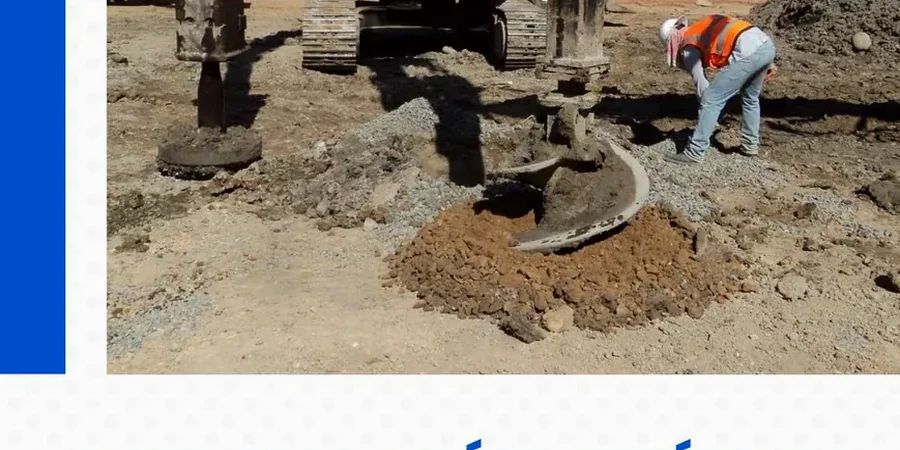
One lesson we have learned repeatedly in Fort Worth is that ignoring the seasonal moisture cycle in expansive near-surface clays can undermine an otherwise sound stone column design. The Eagle Ford formation weathers to a highly plastic clay that swells during spring rains and shrinks during the July-August drought, imposing vertical strains on the upper few feet of any treated zone. If the stone columns terminate too close to grade without a competent load transfer platform, differential heave between the stiffer column heads and the surrounding clay can crack slab-on-grade floors within the first two years of service. Our designs include a minimum 18- to 24-inch thick engineered granular mattress bridging the column tops, reinforced with geogrid when the structural loads or heave potential warrant it. Another risk specific to the Trinity River corridor involves artesian conditions in deeper sand lenses encountered during column installation; without proper casing or fluid control, the vibratory probe can create preferential flow paths that complicate construction and reduce compaction effectiveness. We map these hazards during the site investigation phase using CPT pore pressure dissipation tests so the installation methodology accounts for them before the first column goes in.
Our services
Our Fort Worth ground improvement practice covers the full lifecycle of stone column projects, from feasibility assessment through post-installation verification. Each phase builds on site-specific geotechnical data rather than generic assumptions about North Texas geology.
Feasibility and Preliminary Design
We evaluate CPT and SPT logs, consolidation test data, and groundwater conditions to determine whether stone columns are technically and economically viable for your Fort Worth site. Deliverables include estimated area replacement ratios, column depth requirements, and comparative analysis against alternative ground improvement methods.
Detailed Design and Specifications
Full design package covering column diameter, grid spacing, depth of treatment, stone gradation (typically AASHTO No. 57 or equivalent), load transfer platform details, and staged loading sequence where required. Specifications align with FHWA-NHI-16-027 and are ready for contractor bidding.
Quality Assurance and Load Testing
On-site verification during and after installation, including modulus load tests on individual columns, zone load tests on column groups, and CPT soundings between columns to confirm densification. We provide stamped engineering reports documenting compliance with design parameters.
Quick answers
What soil conditions in Fort Worth make stone columns a good choice versus deep foundations?
Stone columns work well in the soft alluvial clays and loose silty sands common along the Trinity River and its tributaries, where undrained shear strengths are between 300 and 1,000 psf. If the soft zone extends less than about 50 feet and the structure can tolerate modest total settlement — warehouses, embankments, low-rise commercial — stone columns often cost 30 to 50 percent less than driven piles or drilled shafts. For very sensitive structures or extremely thick soft deposits, deep foundations remain the more conservative path.
How do you verify that the stone columns are performing as designed?
We specify a combination of modulus load tests on individual columns following procedures adapted from ASTM D1143, zone load tests covering groups of four to nine columns, and CPT soundings in the treated soil between columns. The CPT data confirms densification and allows us to back-calculate the composite shear strength. For larger projects, we may also run plate load tests on the granular load transfer platform to verify load distribution.
What is the typical cost range for stone column design in Fort Worth?
For the engineering design phase — including geotechnical review, column layout, load transfer platform specifications, and quality control testing procedures — fees typically range from US$1,310 to US$5,570 depending on the treated area, number of column zones, and complexity of the soil profile. The installation cost by a specialty contractor is separate and varies with depth, diameter, and site access.
How long does the design process take from investigation to final specifications?
Assuming the geotechnical investigation is complete, preliminary design takes about one to two weeks. Detailed design with final column layouts, load transfer platform details, and construction specifications typically requires three to four additional weeks. If supplementary CPT testing is needed to refine the soil profile at column locations, we add one week for field work and data interpretation.
Can stone columns be installed adjacent to existing structures in downtown Fort Worth?
Yes, but with careful planning. The vibratory probe generates ground vibrations that can affect nearby utilities, historic masonry, and occupied buildings. We assess vibration thresholds based on structure type and distance, and specify monitoring with seismographs during installation. In tight urban sites, we may recommend pre-drilling through fill or stiff upper layers to reduce vibration amplitude before engaging the vibrator in the deeper soft zone.