We still see it on Fort Worth job sites: a builder assumes a standard cantilever wall will hold back ten feet of native clay, only to find the base sliding toward the sidewalk six months later. Fort Worth sits on the Eagle Ford Shale and Woodbine formations, which produce highly plastic, moisture-sensitive soils. A wall that works fine in San Antonio will fail here if the backfill swells behind the stem. Our team approaches retaining wall design in Fort Worth by starting with the PI, the seasonal water table, and the actual earth pressure envelope. It is not about copying a standard detail; it is about matching the reinforcement schedule and drainage details to what the soil profile shows us. For sites near the Trinity River, where alluvium hides old channel deposits, we often combine the wall analysis with a soil investigation using SPT drilling to define the bearing stratum before sizing the footing.
In Fort Worth, the biggest threat to a retaining wall is not the retained height; it is the volume change of the backfill clay during our wet-dry seasonal cycles.
Technical details of the service in Fort Worth
Procedure video
Risks and considerations in Fort Worth
A few years ago, we reviewed a retaining wall design in Fort Worth for a medical office building off I-20. The original plans called for a 14-foot cast-in-place wall with a standard gravel drain and no global stability check. The boring logs showed a thin layer of weathered shale dipping toward the excavation at about twelve degrees. When we ran the Bishop slope stability model, the factor of safety was below unity for the construction phase. The fix involved extending the footing key deeper into the unweathered shale and adding a row of soil nails to lock the slope during the excavation. If that project had gone to construction without our review, the wall would likely have failed during the first heavy spring rain. Retaining wall design in Fort Worth must consider not just the wall itself but the entire soil mass behind and beneath it.
Our services
Our retaining wall design services in Fort Worth cover the full range of earth retention solutions, from schematic design through construction observation. We work with developers, architects, and general contractors across Tarrant County.
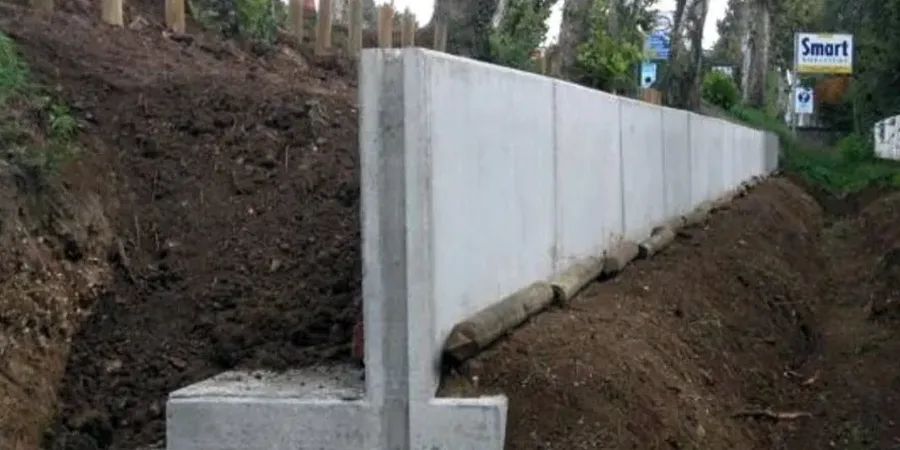
Gravity and Cantilever Wall Design
Reinforced concrete and masonry walls for residential and commercial projects, with structural calculations for stem, heel, toe, and key dimensions.
MSE and Segmental Block Walls
Mechanically stabilized earth walls with geogrid reinforcement, including internal and external stability checks per NCMA and FHWA guidelines.
Shoring and Temporary Earth Retention
Design of soldier pile and lagging walls, sheet pile walls, and soil nail walls for deep excavations in urban Fort Worth sites.
Quick answers
What type of retaining wall is best for the expansive clay soils in Fort Worth?
For expansive clays common in Fort Worth, we often recommend segmental block walls with geogrid reinforcement. These systems tolerate some movement without cracking. For taller walls, a cast-in-place cantilever wall with a solid drainage system and a deep footing key works well. The key is isolating the backfill from the retained native clay to reduce swell pressure against the wall.
Do I need a geotechnical investigation before designing a retaining wall in Fort Worth?
Yes, a geotechnical investigation is essential. You need to know the soil stratigraphy, shear strength parameters, and groundwater conditions. Without borings, you cannot reliably calculate earth pressures or size the footing. The Eagle Ford Shale in Fort Worth can vary significantly in strength over short distances, so guessing is risky.
What is the typical cost range for retaining wall design services in Fort Worth?
For a typical retaining wall design in Fort Worth, our engineering fees range from US$970 to US$3,700, depending on wall height, complexity, and whether the project requires a full geotechnical report or just structural calculations. A simple garden wall costs less; a 20-foot MSE wall near a property line costs more due to the additional analysis and coordination required.